
The artist
Wada Sanzo, the artist behind the dictionary
Every palette on this site comes from one man's lifelong obsession with color. Wada Sanzo (和田三造, 1883–1967) was a painter, teacher and costume designer whose 1930s color guides are still in print — and still on designers' desks — nearly a century later.
A painter between two worlds
Born in Himeji, Japan in 1883, Wada trained in yōga — Western-style oil painting — at the Tokyo School of Fine Arts under Kuroda Seiki, one of the pioneers of Western painting in Japan. His breakthrough came early: his 1907 painting South Wind (Nanpū) took the highest prize at the first Bunten, Japan's national art exhibition, and made his name while he was still in his twenties.
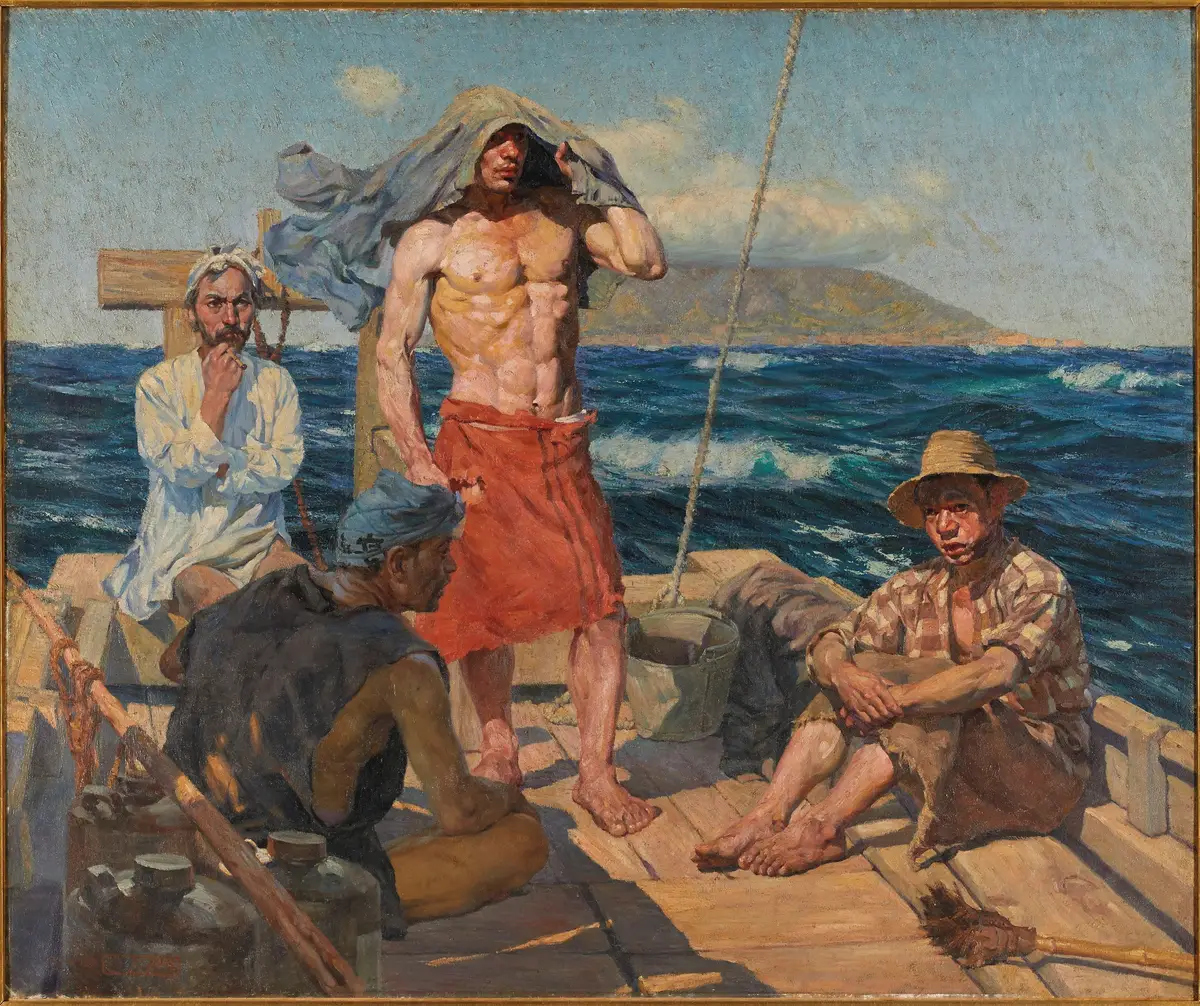
Wada went on to teach at the Tokyo School of Fine Arts, working at the meeting point of traditional Japanese aesthetics and Western color theory — a combination that would define everything he made afterwards.
The Haishoku Sōkan: a color guide ahead of its time
Between 1933 and 1934, Wada published the Haishoku Sōkan (配色総鑑) — a six-volume collection of color combinations intended as a practical guide for Japan's kimono, textile and design trades. Each spread paired precise, hand-selected swatches into combinations of two, three and four colors: quiet lessons in balancing warm against cool, muted against saturated.
Wada also led the Japan Standard Color Association, working to standardize how color was named and reproduced in Japanese industry. The dictionary was never just an art project — it was infrastructure for a design culture.
An Oscar for color
Wada's eye for color eventually reached Hollywood. For Teinosuke Kinugasa's film Gate of Hell (Jigokumon, 1954), he designed the costumes whose saturated silks stunned Western audiences — and won the Academy Award for Best Costume Design, one of the first Oscars ever awarded to a Japanese filmmaker.
The dictionary today
In 2011, the Kyoto publisher Seigensha collected Wada's combinations into a single small volume, A Dictionary of Color Combinations, followed by a second volume in 2020. The books became a quiet phenomenon among designers, illustrators and colorists worldwide — the palettes feel strikingly contemporary despite being nearly a century old.
This site and the Wada Colors app bring those combinations to the web and to your phone: all 348 Volume 1 palettes free to browse with exact HEX, RGB, CMYK and LAB values, a camera scanner that matches real-world colors to Wada's dictionary, and the full Volume 2 collection.